
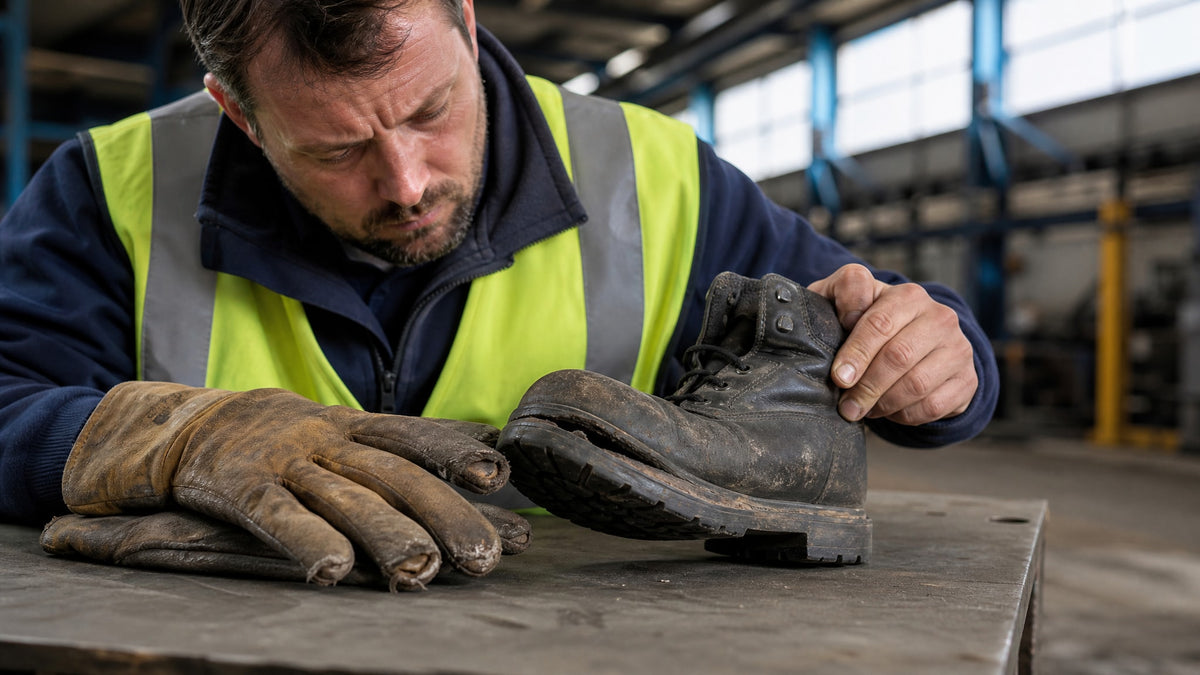
Determining how often PPE should be replaced is rarely a matter of checking a calendar. Equipment fails based on usage intensity, environmental exposure and storage conditions rather than arbitrary time limits. A fixed PPE replacement schedule often leads to either premature waste or dangerous complacency. Procurement teams and site managers need condition-based assessments instead, ones that identify specific failure points across footwear, gloves and protective garments.
This guide outlines the practical indicators that show when safety equipment has reached its end of life. It moves past generic advice to address the specific wear patterns seen in UK industrial environments, so you can tell the difference between minor maintenance issues and critical failures that demand immediate withdrawal from service.
Legal Responsibilities for PPE Replacement in the UK
UK employers carry a non-negotiable duty to maintain personal protective equipment in efficient working order and good repair under current health and safety regulations. This obligation extends beyond the initial purchase. Businesses must establish systems that keep gear effective throughout its service life, rather than assuming protection persists indefinitely after issue. HSE guidance states that reusable PPE must be cleaned, maintained in good condition, and repaired using correct replacement parts following manufacturer instructions.
You cannot hand this responsibility entirely to individual employees who may lack the training to spot subtle degradation. Workers should report defects, yes, but the employer has to provide the framework for inspection, the budget for timely replacement and the records proving compliance during an audit. Ignoring workwear replacement guidelines because equipment looks superficially intact exposes the business to liability if an incident reveals a material failure that routine checks would have caught.
Replacement is a legal duty, not optional best practice.
Safety Footwear Lifespan and Inspection Triggers
Safety boots do not expire on a specific date. They fail through measurable mechanical degradation that varies by model and by environment. A boot worn daily on abrasive concrete will reach end of life months before an identical pair used intermittently in dry warehousing. That's why visual inspection beats calendar-based rotation for deciding when to replace safety boots.
Recognising Sole Wear and Upper Damage
The sole unit typically fails before the protective toe cap, particularly in high-abrasion environments where tread depth diminishes rapidly. The Argon S3 Safety Boot, priced around £15.20, features a dual-density PU sole designed for slip and fuel resistance, but even durable soles need regular inspection for wear patterns that compromise grip or expose the midsole to penetration hazards. Once the tread pattern flattens below safe thresholds, or the sole shows signs of delamination from the upper, the boot no longer provides certified protection, regardless of how pristine the leather looks.
Upper damage presents different risks depending on the material. Premium options like the Rockfall Lava, priced around £187.50, use water-repellent full-grain leather for demanding environments, yet leather uppers still crack and degrade if they aren't maintained or replaced when damaged. Microfibre uppers on lighter models resist water better at first but can tear catastrophically once abraded. Stitched seams on any boot type are common failure points, letting in liquids or debris long before the main material gives out.
When to Replace Components vs Entire Boots
Not every defect means discarding the entire boot, provided the structural integrity holds up. WorkStuff UK supplies replacement components such as Portwest FL02 Steelite boot laces, priced around £1.25, so teams can extend footwear service life without replacing entire boots over minor failures like broken lacing or worn eyelets. This cuts waste and cost, but only when the protective elements themselves remain intact and functional.
Compromised toe caps, penetrated midsoles or separated sole units mean complete replacement, immediately. These failures can't be repaired safely or legally, because the boot's certification depends on the original manufacturing process staying unaltered. If you're unsure whether damage is cosmetic or structural, err on the side of withdrawal and consult our guide on choosing the right work boots to select replacements matched to your specific hazard profile.
Browse the full safety footwear range once inspections confirm that boots have reached end of life.
Glove Wear Inspection and Change Intervals
Gloves present the most variable lifespan of any PPE category, because their degradation rate depends entirely on the task rather than the product specification alone. A cut-resistant glove handling sharp metal swarf may last days, while the same model used for general assembly could serve safely for weeks. That makes glove wear inspection a daily necessity, not a periodic formality.
Cut-Resistant vs General Handling Gloves
Mechanical protection degrades visibly through fibre breakage, thinning at contact points and loss of elasticity in the cuff. Understanding construction safety glove cut levels helps you recognise when a glove has dropped below its rated protection threshold, since damaged fibres no longer distribute cutting forces across the fabric matrix. Any visible hole, significant abrasion exposing inner layers, or a stretched cuff that lets debris in, means the glove must be withdrawn immediately, regardless of how recently it was issued.
General handling gloves fail differently, often losing grip texture or dexterity before developing holes. Coated palms smooth out with use, reducing friction and raising the odds of dropped loads even though the base fabric looks intact. Replace these based on performance loss you spot during pre-use checks, rather than waiting for a physical breach. Reduced grip is a hazard in itself.
Signs of Chemical or Thermal Degradation
Chemical-resistant gloves degrade invisibly through permeation, which compromises barrier protection long before surface damage appears. Stiffness, swelling, discolouration or unusual odours all point to chemical breakthrough that makes the glove unsafe, even with no visible tears. Thermal gloves lose insulating capacity when compressed repeatedly or exposed to moisture. Replace them once they feel thinner or transmit heat noticeably faster than when new.
Never assume gloves are safe because they look clean.
Hi-Vis and Protective Workwear Replacement Schedule
High-visibility clothing loses its protective function through fading, soiling and fabric thinning that reduces retroreflective performance below EN ISO 20471 standards. Unlike footwear or gloves, where failure is often sudden, hi-vis degradation is gradual and easily normalised by daily wearers who adapt to diminishing brightness over time. That's why scheduled audits matter for maintaining compliance.
Soiling is a particular problem, because dirt masks reflective tape and dulls fluorescent fabrics, sometimes permanently. Washing restores visibility temporarily, but repeated laundering also degrades the fluorescent dyes and damages retroreflective tape adhesives, creating a finite wash cycle limit that manufacturers specify. When garments no longer meet luminance requirements after cleaning, replacement is mandatory regardless of structural condition.
Branded uniforms add another layer beyond pure safety compliance. Companies issuing branded hi-vis vests need to coordinate replacement across teams to keep corporate appearance consistent alongside regulatory adherence, since mismatched fading between old and new garments undermines a professional look. Bulk ordering aligned with inspection cycles gets all staff fresh garments at the same time, rather than piecemeal replacements that create visual inconsistency.
Fabric thinning at stress points like elbows, knees and pocket edges signals end of life for general workwear even when hi-vis properties remain adequate. Worn fabric tears easily, exposes skin to hazards, and suggests a broader neglect of uniform standards that auditors will note during inspections.
Head, Eye and Hearing Protection Service Life
Hard hats, safety eyewear and hearing protection follow manufacturer-stated shelf lives that differ fundamentally from the usage-based wear patterns seen in other PPE categories. Most hard hats carry an expiration date moulded into the shell, typically three to five years from manufacture, because UV exposure and temperature cycling degrade the polymer structure invisibly over time, regardless of whether the hat has ever been worn.
Any impact, drop or visible crack voids the hard hat's certification immediately and means replacement before further use. Sweatbands and harnesses deteriorate faster than shells and should be replaced according to manufacturer intervals, or sooner if they show fraying, stiffness or loss of elasticity that affects fit and retention.
Safety eyewear scratches progressively, reducing optical clarity and causing eye strain that raises accident risk independently of impact protection. Deep scratches in the lens centre, coating delamination, or frame distortion that prevents a proper seal against the face, all warrant immediate replacement. Compromised vision is itself a workplace hazard. Hearing protection loses effectiveness when foam earplugs go stiff or dirty, or when earmuff cushions harden and fail to seal against the head, so pair visual inspection with a regular tactile check.
Building a PPE Inspection Checklist for Your Team
Turning replacement principles into consistent practice takes documented processes that survive staff turnover and hold up under regulatory scrutiny. A solid safety equipment inspection checklist assigns specific checkpoints to named roles, sets minimum frequencies based on hazard severity, and creates auditable records that show proactive management rather than reactive response to incidents.
Recordkeeping for Compliance Audits
Documentation proves diligence when regulators question whether replacement decisions were timely and appropriate. Our PPE compliance checklist provides a ready-made template for recording inspection dates, findings and actions taken, building an evidence trail that protects both employer and employee during investigations. Digital records linked to individual staff members allow trend analysis that flags premature failures pointing to incorrect product selection or training gaps.
Keep records for at least three years to cover typical enforcement windows and support insurance claims. Include photographs of damaged items withdrawn from service, since visual evidence strengthens compliance narratives far more than text descriptions alone.
Setting Internal Review Frequencies
Inspection frequency should match the degradation rate rather than defaulting to a convenient administrative cycle. High-wear items like gloves and boots need daily user checks backed by weekly supervisor verification, while lower-turnover equipment like hard hats may only need monthly formal inspection despite daily pre-use visual checks by wearers. Aligning inspection cycles with bulk workwear procurement schedules streamlines reordering by flagging replacement needs before stock runs critically low.
Review your frequencies quarterly against actual withdrawal data to calibrate the intervals properly. If inspections consistently find equipment in perfect condition, you may be checking too often and wasting supervisory time. If failures regularly turn up between checks, tighten the frequency to close the safety gap.
Sourcing Reliable Replacement PPE at Scale
Scheduled replacement programmes fail when supply chains can't deliver consistent quantities at predictable intervals. If you're managing an ongoing PPE replacement schedule, a trade account with a supplier who understands commercial volume requirements beats relying on ad-hoc retail purchases that fluctuate in price and availability.
WorkStuff UK supports business customers nationwide with dedicated services for bulk ordering, branded uniform coordination and credit facilities subject to approval. Leicestershire and East Midlands clients benefit from a strong local presence and rapid fulfilment, while national accounts get the same product range and service standards through established logistics partnerships. Enquire about business credit accounts to align payment terms with your procurement cycles and secure priority allocation during peak demand periods.
Consistent supply prevents safety gaps caused by stockouts.
Frequently Asked Questions
How long should PPE last in typical UK industrial use?
PPE lifespan varies dramatically by item type and usage intensity rather than following universal timelines. Safety boots typically last three to twelve months depending on abrasion levels, while hi-vis garments may remain compliant for six to eighteen months based on washing frequency and UV exposure. Always defer to condition-based inspection over calendar dates, as manufacturer guidelines assume standard conditions that rarely match actual site environments.
How often is PPE required to be inspected under UK regulations?
UK law requires PPE to be maintained in efficient working order, which necessitates inspection frequencies matched to degradation rates rather than fixed statutory intervals. High-wear items like gloves and footwear need daily user checks plus weekly supervisory verification, while hard hats and eyewear may suffice with monthly formal inspections alongside pre-use visual checks. Document every inspection to demonstrate compliance during HSE audits or incident investigations.
When should we change PPE if it looks undamaged?
Replace PPE when it reaches manufacturer-stated expiry dates, fails performance tests or no longer meets relevant standards, even without visible damage. Hard hats expire due to polymer degradation invisible to inspection, chemical gloves lose barrier protection through permeation, and hi-vis fabrics fade below luminance thresholds despite appearing clean. Condition-based assessment combined with documented service life tracking prevents false security from superficial appearances.