
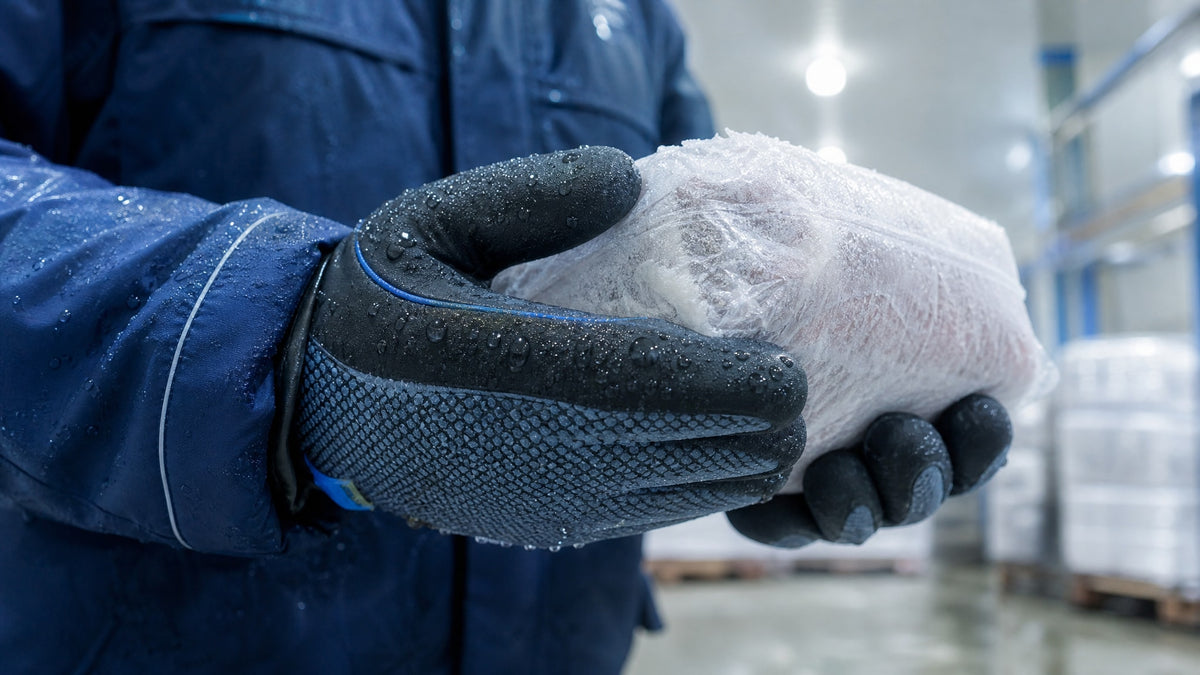
Picking the right cold store gloves for freezer work is a safety decision, not just a procurement one. It affects staff welfare and, if you get it wrong, it affects output too. Standard warehouse hand protection doesn't do the job in sub-zero temperatures, where prolonged exposure brings cold injury and a steady loss of manual dexterity. Buyers need to check insulation ratings, grip performance and ergonomic design to stay compliant with UK health and safety rules while keeping work moving.
Why Standard Gloves Fail in Cold Storage Environments
General-purpose work gloves aren't built to protect hands in freezer conditions, and employers who assume standard PPE will do create a real safety liability. Moisture from condensation or frozen packaging gets into non-specialised gloves fast. That wrecks the thermal barrier, speeds up heat loss, and raises frostbite risk over a long shift.
Insulation in ordinary gloves compresses under the weight of heavy frozen goods. That squeezes out the air pockets that provide thermal resistance, so a worker can be wearing gloves and still be at risk. Generic warehouse gloves were never built for sustained cold exposure, and they won't keep skin at a safe temperature once ambient conditions drop below freezing.
Cold store PPE needs manufacturing specifications that deal with convective heat loss and direct contact with frozen surfaces at the same time. If a freezer worker is given inadequate hand protection, that's a failure of duty of care under UK workplace safety law, whether or not an injury has happened yet.
Understanding Thermal Ratings for Freezer Gloves UK
Procurement teams often misread thermal performance data when sourcing freezer gloves UK suppliers offer, and that leads to gloves that don't protect staff at the temperatures they'll actually face. EN 511 certification gives you the objective framework to match a glove's specification to your facility's real thermal conditions, rather than relying on marketing claims.
Decoding EN 511 Standards
EN 511 tests three things separately: convective cold resistance, contact cold resistance, and water penetration resistance. Each gets its own score, so buyers get precise specification data rather than one blended rating. Convective cold ratings run from 0 to 4 and show how well a glove insulates against circulating cold air, the kind that matters when staff are standing still or moving slowly between tasks in a freezer.
Contact cold ratings also run 0 to 4. They measure protection when handling frozen objects directly, which matters for order pickers and loaders who grip metal racking or frozen product packaging all shift. Water penetration is scored pass (1) or fail (0), and it tells you whether the glove keeps its insulating properties when melting ice or condensation gets on it, which happens often in chillers moving between temperature zones.
Matching these ratings to your actual freezer zone matters because a glove rated fine for -20°C chill storage can be dangerously short of what -30°C deep freeze work demands. Our safety glove standards guide sets out how thermal testing differs from the cut-resistance testing most procurement teams already know.
Contact vs Convective Cold Protection
Knowing the difference between contact and convective cold protection stops expensive specification mistakes when you're outfitting teams for mixed freezer duties, some static, some active handling. Convective protection matters most for staff standing still during quality checks or stocktakes, where they're generating little body heat and the surrounding air keeps drawing warmth from exposed skin.
Contact protection matters during loading, unloading and picking, where hands keep touching frozen metal, plastic or cardboard that pulls heat away far faster than air does. A glove that's great on convective insulation but weak on contact rating will let down anyone doing physical handling, even if it felt warm enough in a quick wear trial.
Specify minimum performance levels for both metrics based on what the job actually involves, not on a single-purpose glove that only covers one type of cold exposure. That way the gloves cover the full range of tasks your freezer staff do in a day.
Balancing Grip and Insulation in Low Temperature Safety Gloves
Thermal bulk and tactile sensitivity pull against each other. Every extra layer of insulation costs some of the dexterity workers need to handle small items, work controls or read labels. Choosing low temperature safety gloves means being honest about what tasks staff actually do, rather than assuming maximum insulation is automatically the safer choice.
Grip failure in freezer conditions causes its own problems: dropped loads, damaged stock, and awkward compensatory movements that raise the risk of musculoskeletal injury on top of the cold itself. Textured palm coatings built for cold environments keep friction on frosted surfaces without workers needing to grip harder, which protects both safety and output on repetitive handling jobs.
Palm Coatings for Wet and Dry Handling
Nitrile and latex palm finishes designed for cold work stay flexible at sub-zero temperatures, where standard coatings go stiff and lose grip altogether. Sandy or foam nitrile textures create tiny channels that push surface moisture off frozen packaging, so they hold onto wet cardboard and shrink wrap that would slide straight out of a smooth-coated glove.
Test grip performance under real working conditions before committing to a bulk order. Laboratory ratings don't always predict how a glove handles an irregularly shaped frozen item in practice. Dry-handling work in blast freezers may call for a different coating than damp chiller work, where condensation keeps forming on both surfaces and gloves.
Dexterity Trade-offs in Deep Freeze Conditions
Deep freeze work below -25°C needs thicker insulation, and that costs fine motor control. Buyers end up choosing between accepting reduced dexterity or rotating staff to limit how long anyone's in there continuously. Pre-curved fingers and articulated knuckle zones help by aligning the glove's shape to how a hand naturally grips.
Some operations do better with liner systems, letting workers swap outer shells between a high-dexterity option and a maximum-insulation one depending on the task in front of them, rather than wearing one glove that compromises on both all shift. No single glove is the right answer for every freezer task, and accepting that early avoids unrealistic expectations later.
Essential Features for Warehouse Cold Handling Gloves
Beyond the insulation rating, design details decide whether cold handling gloves hold up in real warehouse work or just pass a lab test. Extended cuffs and wrist seals stop cold air getting in when arms reach overhead, which is a common cause of localised cold injury even when the palm insulation is solid.
Keeping skin fully covered matters in freezer environments, which is why extended cuff designs help prevent frostbite during overhead reaching. High-visibility colours and reflective elements aren't just about identification either: they help supervisors check compliance at a glance and help spot staff quickly in dim freezer aisles.
Extended Cuffs and Wrist Seals
Knit wrist cuffs extending 75mm or more beyond the glove body overlap with jacket sleeves, which blocks draughts when arms go up above shoulder height during racking work. Elasticated inner seals or adjustable strap closures tighten that overlap further against cold air getting in during active movement, which is most of what order fulfilment work involves.
Gauntlet-style cuffs give better protection at the point workers enter or leave a deep freeze, where the temperature difference whips up strong convective currents around the wrist opening. A longer cuff costs no more than a standard wrist-length glove, but it prevents injuries that standard gloves don't.
Visibility and Identification in Chillers
Fluorescent orange, yellow or lime colours stand out against white frost and grey racking, which is most of what a commercial freezer interior looks like. Reflective piping or printed strips help people get spotted under the artificial lighting typical of automated storage facilities, where vehicle operators and monitoring systems need to see a person is there.
Colour-coding by size, department or shift helps with stock control and compliance checks without staff having to check internal labels mid-shift. These visual cues fit into wider site safety protocols as well as doing a practical job on their own.
Integrating Cold Store Gloves into Wider Freezer PPE
Hand protection is one piece of a thermal safety system. It can't make up for gaps elsewhere in your PPE. Our warehouse staff safety kit checklist places gloves alongside insulated footwear, headwear and torso layers, because it's the combination that keeps core temperature up during extended freezer exposure.
Rechargeable LED Light gloves give workers built-in illumination for low-light tasks in chillers, useful in confined spaces, which is where plumbers, electricians and mechanics tend to use them, but their thermal suitability for deep-freeze work needs checking separately before you treat them as primary cold protection. Confirm the EN 511 rating matches your actual operating temperature rather than assuming a light built into the thumb means the glove is warm enough.
Meeting PPE compliance requirements means documenting every thermal hazard in your facility and checking that what you've issued covers each one. Gloves alone won't satisfy that obligation if staff don't also have proper foot insulation, face protection or layered clothing for sustained sub-zero work.
Sourcing Thermal Gloves for Warehouse Teams at Scale
Buying thermal gloves in bulk for warehouse teams raises questions an individual purchase doesn't: size spread, how often gloves need replacing, and who's accountable for them. Keeping enough stock across shifts means forecasting usage against task intensity, how harsh the environment is, and your own wear history, not a generic industry rule of thumb.
Setting up a business credit account with a specialist supplier makes budgeting and reordering more predictable, cutting the admin load on whoever manages your PPE supply. WorkStuff UK works with commercial customers on volume quotations and tailored supply arrangements for cold store glove programmes, including large or spread-out workforces.
Managing Stock Levels for Shift Workers
Look at the size spread from an initial trial period to set stock ratios that avoid running short on common sizes while not over-ordering sizes nobody needs. Glove lifespan also shifts with the season: summer hires without cold-condition experience tend to wear gloves out faster, so replenishment schedules need adjusting at peak staffing times.
Buffer stock should cover unexpected contamination, spikes in damage during busy periods, and the lead time on specialist cold-rated products from your supplier. Running out of compliant gloves forces a bad choice between stopping work or letting staff carry on under-protected, so proactive stock management is a safety measure, not just admin.
Branding and Compliance Tracking
Embroidered logos or printed identifiers on cold store gloves help with asset recovery, discourage staff swapping in non-compliant gloves of their own, and make compliance audits simpler. Our branded PPE services apply permanent marking that survives the laundering and wear a reusable freezer glove goes through.
Visible branding also makes clear the gloves are issued, mandatory safety kit, not something optional. Linking branded gloves to individual workers or departments through a tracking system improves accountability and lets you target replacement at actual usage rather than a blanket calendar swap.
Maintaining and Replacing Cold Storage Hand Protection
Insulated freezer gloves fail in ways a casual look won't catch, so you need a structured way to check them before thermal protection drops off. Following a documented PPE replacement schedule keeps renewal tied to observable condition rather than reacting after something's gone wrong.
Lining compression is the most common failure in cold store gloves. Repeated use flattens the insulating fibres and squeezes out the trapped air that provides thermal resistance, and none of that shows from the outside. Coating delamination, seam separation and damp retained in the lining weaken a glove the same way, without an obvious visual warning during a routine check.
Damp gloves lose insulating capacity fast compared with dry ones, so proper drying between shifts matters as much as checking physical condition. Commercial sites should run a rotation that gives gloves time to dry rather than expecting one pair to cope with back-to-back shifts without the insulation dropping off.
How long a glove lasts depends on how abrasive the task is, how long the exposure runs, how often it's laundered, and how an individual wears it. A fixed calendar schedule is often either too early or dangerously late. Supervisors trained to apply condition-based criteria during regular checks tend to get better safety outcomes, and lower cost, than a replacement policy set to an arbitrary date.
Frequently Asked Questions
What are the best gloves to wear when working in a freezer?
The best freezer gloves carry EN 511 certification with convective and contact cold ratings matched to your specific operating temperature, typically level 3 or 4 for deep freeze environments below -25°C. Look for textured nitrile or latex palm coatings that maintain grip on frozen surfaces and extended knit cuffs preventing cold air entry during overhead work. No single glove suits all freezer tasks, so consider task-specific selection or liner systems for operations mixing high-dexterity and maximum-insulation requirements.
What PPE is legally required for working in a freezer?
UK regulations require employers to provide suitable PPE following documented risk assessment identifying all cold hazards present in the facility, including hand, foot, head and torso protection appropriate to temperature and exposure duration. There is no universal list specifying exact products; instead, you must demonstrate that selected equipment addresses identified risks and that staff receive training on correct use. Records showing EN 511 ratings matching operational temperatures, issue logs and replacement schedules form the evidence base inspectors expect during compliance audits.
How to keep hands warm while working in a freezer?
Maintain hand warmth through properly rated EN 511 gloves with adequate convective and contact cold protection for your specific freezer temperature, ensuring dry linings and intact insulation throughout each shift. Implement glove rotation allowing thorough drying between uses, as damp insulation loses thermal capacity rapidly regardless of external condition. Consider liner systems or task rotation limiting continuous exposure periods when deep freeze conditions demand thick insulation that reduces dexterity below functional thresholds.
How often should insulated freezer gloves be replaced?
Replace insulated freezer gloves when lining compression eliminates thermal air pockets, coatings delaminate, seams separate or moisture retention persists despite proper drying procedures. Fixed calendar intervals rarely suit commercial operations where wear rates vary by task, user and environmental severity; condition-based assessment by trained supervisors typically delivers better safety and cost outcomes. Documented inspection records supporting replacement decisions demonstrate due diligence during compliance reviews and help refine future procurement forecasting.