
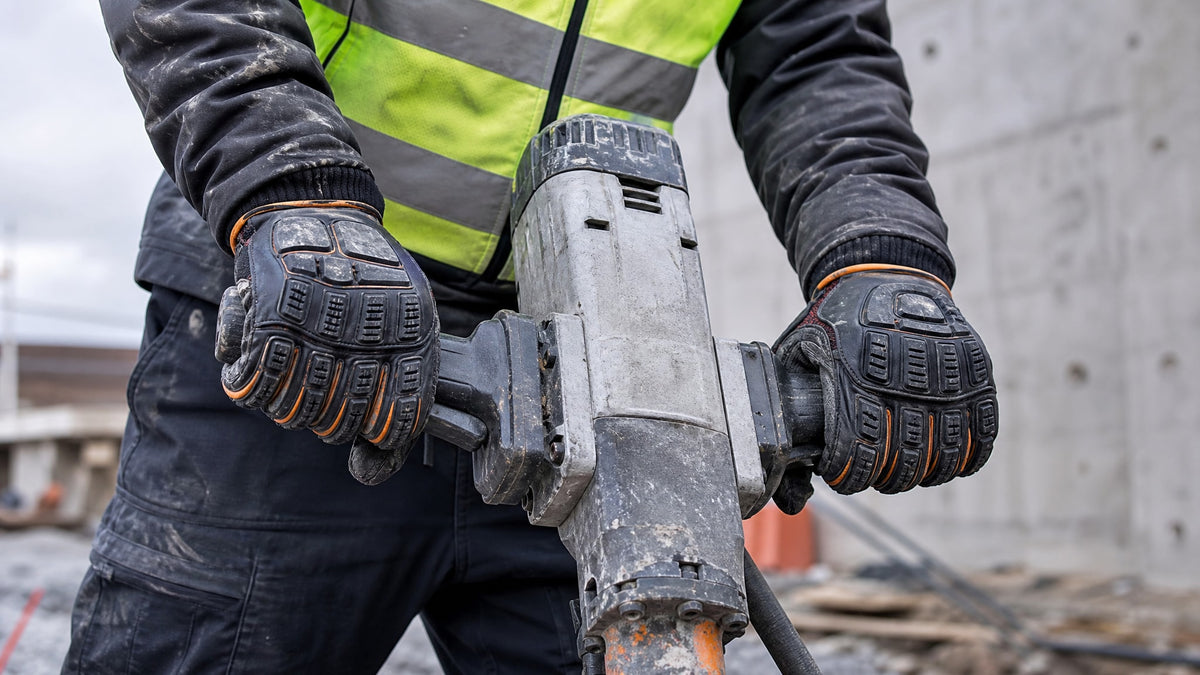
Hand-Arm Vibration Syndrome affects thousands of UK construction workers every year. The HSE names it as one of the leading causes of occupational ill health in the sector. Picking the right anti-vibration gloves for construction work means telling genuine risk reduction apart from basic hand comfort, because standard work gloves don't protect against harmful vibration frequencies. Any glove that claims protective qualities needs to meet specific testing standards. Durability claims and marketing copy aren't enough on their own. WorkStuff UK has supplied compliant PPE to UK construction firms for over 20 years, and stocks only gloves meeting the relevant CE and EN standards.
Understanding HAVS and Anti-Vibration PPE Requirements
What are Hand-Arm Vibration Syndrome regulations?
UK law places strict duties on employers to manage vibration risks under the Control of Vibration at Work Regulations 2005, which set both an Exposure Action Value and an Exposure Limit Value for daily tool use. These UK PPE legal requirements mean you assess the risk before you choose controls, so the equipment you issue actually addresses the hazard your assessment identified. Gloves claiming anti-vibration properties must be tested to ISO 10819 to verify transmissibility reduction. Untested products can offer false security when used with high-vibration machinery.
How vibration reducing gloves fit into risk control
Anti-vibration PPE is a secondary control measure. It supports engineering solutions, such as tool maintenance, low-vibration equipment procurement, or job rotation, but never replaces them. Gloves alone won't get you compliant if your primary risk elimination strategies fall short for the tools your team uses daily. A PPE compliance checklist helps procurement staff check that selected gloves meet the wider regulatory obligations alongside other mandatory site equipment.
Key Features of Effective Anti-Vibration Gloves for Construction
Padding materials and dampening technology
Effective vibration reducing gloves use specific foam densities or gel inserts, placed at the palm and finger contact points where transmission hits hardest. The thickness and composition of that padding decide which frequency ranges the glove actually attenuates. A glove built for impact drivers will differ fundamentally from one built for orbital sanders. Generic padding without certified test data cushions the hand, but it doesn't guarantee any measurable cut in transmitted vibration force.
Grip, dexterity and ergonomic design
Workers need enough tactile feedback to operate triggers and adjust settings safely. Padding that's too thick can wreck grip and introduce new hazards even as it cuts vibration exposure. Ergonomic designs that follow the hand's natural curve reduce muscle fatigue over a long shift, so workers keep proper tool control without having to strip the gloves off. Get that balance between dampening and dexterity right, and the gloves actually stay on hands instead of getting left in a van.
Durability standards for site use
Construction sites need abrasion resistance that holds up across weeks of heavy use. Compressed or torn padding loses its dampening effect immediately. Breathability matters too, since trapped moisture degrades liner materials and irritates skin, particularly in summer or on physically demanding tasks. Where sharp materials are also present, it's worth checking vibration protection against cut-resistant glove standards as well, because a single-purpose glove can leave a secondary hazard uncovered.
Comparing WorkStuff UK's General Handling Gloves for Vibration Tasks
Grip 15 Foam Nitrile Bamboo Glove
The Grip 15 Foam Nitrile Bamboo Glove, priced around £54.19 for a pack of 12, uses a 15-gauge bamboo viscose liner that resists UV degradation and keeps its cushioning through prolonged outdoor use. It's breathable and hypoallergenic, which suits workers with sensitive skin, and the soft nitrile foam coated palm grips well in both wet and dry conditions. It's a strong option for general construction work needing sustained comfort alongside moderate vibration dampening, though you'll still want to check it against your specific tool vibration data.

GP Grip 21 Nitrile Micro Foam Glove
For precision handling where fine motor control matters most, the GP Grip 21 Nitrile Micro Foam Glove, priced around £5.31, has an ergonomic design built to reduce hand fatigue during detailed assembly or inspection work. The 21-gauge construction gives better dexterity than heavier models, which suits smaller vibrating tools where bulkier padding would get in the way. It's dermatologically tested and OEKO-TEX STANDARD 100 certified, meaning it's free from harmful substances and comfortable for all-day wear.

Grip 13 Latex Crinkle Essential Multipack
The Grip 13 Latex Crinkle Essential Multipack, priced around £9.04 for a pack of 12, has a waterproof latex coating with a crinkled texture that holds its grip in damp or oily conditions common on active sites. The seamless knitted liner and ergonomic shape keep it flexible, and the breathable open back cuts down on perspiration through a long shift. It's a streamlined, lower-cost option for teams that need reliable general handling protection across several vibration-prone tasks.
Mechanical and Leather Gloves for Heavy-Duty Vibration Protection
Leather 110 Grain Palm Mechanical Glove
The Leather 110 Grain Palm Mechanical Glove, priced around £4.58, is made from durable goat grain leather with reinforced fingertips and a hook-and-loop fastening for a secure fit during demanding mechanical work. Leather's dense fibrous structure dampens some lower-frequency vibration on its own, which synthetic materials can't match without extra padding layers. That makes it suitable for high-impact work where abrasion resistance matters more than fine dexterity or lightweight comfort.

When to choose leather over synthetic anti-vibration PPE
Choose leather mechanical gloves for heavy breakers, chisels, or demolition equipment, where tool weight and impact force outstrip what lighter synthetic gloves can handle. Leather takes rough material handling and sharp edges better than foam-coated fabric, and lasts longer in harsh conditions, even though its dampening is broad-spectrum rather than tuned to a specific frequency. Synthetic gloves still make more sense for higher-frequency tools like grinders or sanders, where padding built for that spectrum does a better job than leather's general absorption.
Lightweight and Disposable Options for Low-Vibration or Hygiene-Sensitive Tasks
Liner 7 PVC Polka Dot Glove
The Liner 7 PVC Polka Dot Glove, priced around £0.54, is lightweight and offers good finger dexterity for dry handling where vibration exposure stays below action values, or where contact with low-intensity sources is brief. The PVC dots improve grip without adding real padding, which suits material sorting, packaging, or light assembly rather than sustained power tool use. It gives no meaningful anti-vibration protection and should never stand in for certified PPE once a risk assessment flags hazardous exposure.

PU Palm Glove Carton for bulk procurement
Procurement teams managing large workforces can source the PU Palm Glove - Carton, priced around £308.13 for 480 pairs, for a steady supply of basic grip protection across warehouse or logistics operations. These gloves suit low-risk handling where warehouse hand protection essentials prioritise dexterity and contamination control over vibration mitigation, and the bulk packaging improves storage and value for sites running frequent replacement cycles.
Nitrile Disp Glove PF Blue for contamination control
The Nitrile Disp Glove PF Blue, priced around £4.91 for a box of 100, meets hygiene needs in catering, beauty, or other public-facing sectors, where visible cleanliness matters more than mechanical protection. It's a CE category III, CE class I examination glove, powder free, and free from phthalates and other softeners. Disposable nitrile gives barrier protection against contaminants, but zero vibration dampening, so it has no place on any task involving powered or vibrating equipment. Its job is contamination control, or brief contact with non-hazardous items where vibration exposure simply doesn't arise.
Selecting the Right Glove Based on Tool Type and Exposure Time
Matching a glove's specification to the tool's actual output and daily usage duration is what decides whether the protection is real or just for show. High-impact breakers and demolition hammers produce low-frequency, high-amplitude vibration, which needs substantial padding mass or leather construction to attenuate it. Angle grinders produce higher frequencies, better handled by foam or gel composites tuned to that range. Your risk assessment's exposure time figures set the threshold: brief, intermittent use may allow general handling gloves with moderate cushioning, but continuous operation past the action values calls for certified anti-vibration PPE, whatever the comfort level feels like.
Standard work gloves don't have the tested dampening needed for HAVS prevention, and shouldn't be assumed sufficient without checking against ISO 10819 or an equivalent standard. Check manufacturer vibration data for each tool model rather than going on general category assumptions. Two similar-looking grinders can transmit very different energy levels depending on motor design and age.
Maintaining and Replacing Anti-Vibration Gloves on Site
Compressed padding, torn palms, or a degraded liner mean the glove has already lost its protective function, and it needs replacing before further use. Damaged gloves transmit vibration almost as freely as bare skin. Regular inspection, timed to usage intensity and site conditions rather than a fixed calendar date, keeps this in line with HSE guidance. Workers should report wear promptly through the usual channels, and supervisors need enough stock on hand to avoid gaps in cover during replacement.
How you wash gloves matters too. Poor laundering can compress foam cells or break down the bond between padding and outer shell, quietly cutting performance before any damage is visible. Store gloves away from direct sunlight and chemical contaminants when not in use, since UV exposure and solvent contact wear materials down in ways routine inspection can miss until the glove fails mid-shift. Logging replacement dates and inspection outcomes builds a record that shows due diligence if your vibration management programme is ever questioned.