
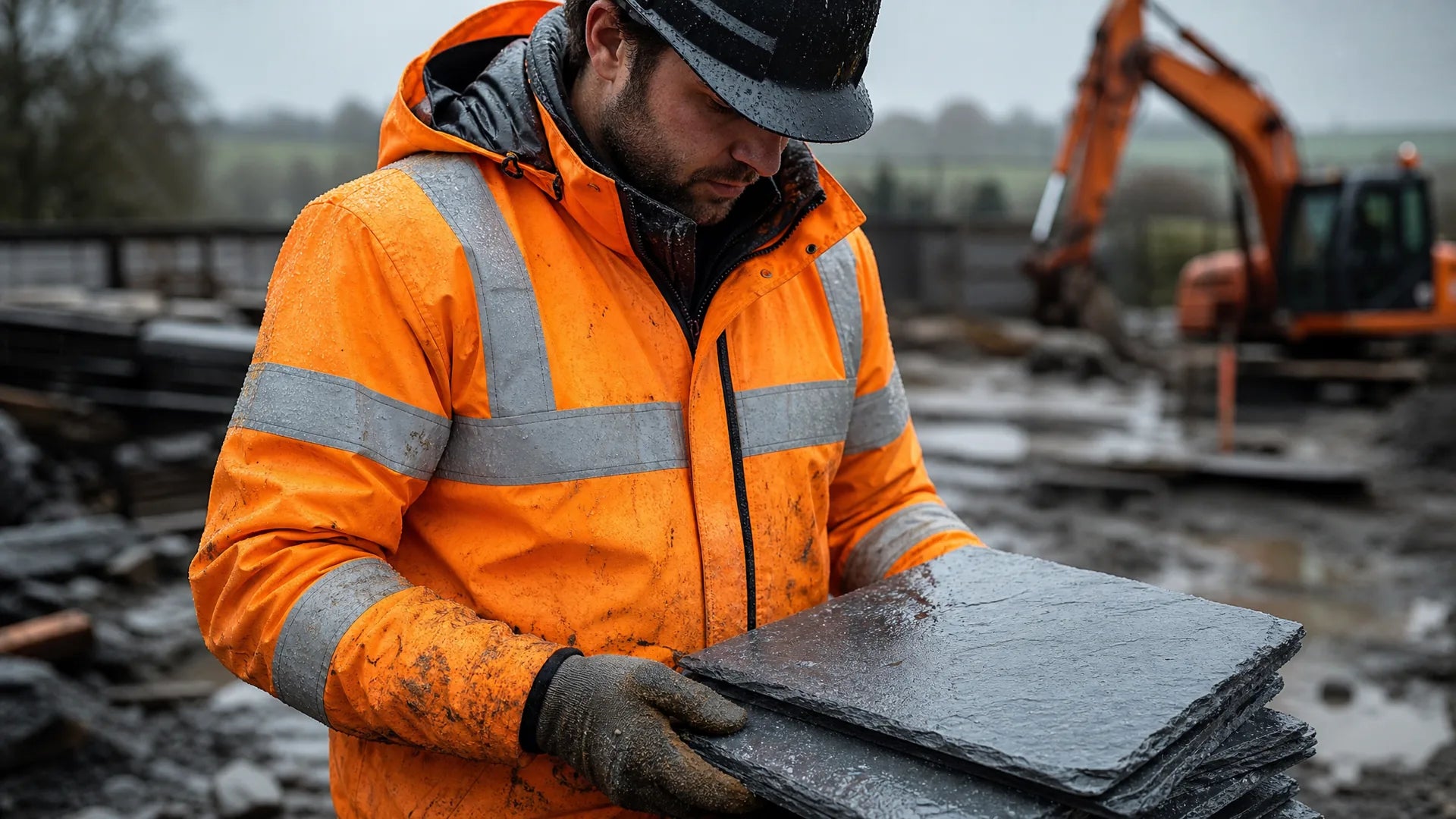
Choosing waterproof workwear jackets for UK trades means looking past generic outdoor marketing and checking specifications built for active industrial environments. A jacket that keeps a hiker dry on a gentle walk can fail completely on a groundworker laying tarmac or a roofer fixing slates in persistent rain. Physical exertion generates moisture that cheap membranes can't shift.
WorkStuff UK has supplied compliant workwear to East Midlands contractors for over two decades. In that time we've noticed teams who prioritise breathability report fewer mid-shift jacket removals and stick to visibility protocols more consistently.
This guide compares specific models on fabric performance, insulation type and compliance standards rather than seasonal trends. We focus on garments built for occupational use, where durability and safety certification matter more than lightweight packability. If you're buying for a hike or the odd afternoon in the garden, you probably don't need specs this heavy. For daily site work, though, they're the difference between staying safe and getting soaked from the inside out.
Understanding Waterproof Ratings and Breathability for UK Trades
Check both hydrostatic head and moisture vapour transmission rate (MVTR) before you commit to a waterproof work coat for your crew. Relying on just one metric leaves workers exposed either to rain getting in or sweat getting trapped. Industry benchmarks for UK outdoor trades put the threshold for all-day comfort in persistent rain, without condensation building up, at a minimum hydrostatic head of 5,000mm combined with an MVTR above 3,000g/m²/24hrs.
Hydrostatic Head vs. MVTR Explained
Hydrostatic head measures the water pressure a fabric can withstand before it leaks, expressed in millimetres of water column height. A rating of 10,000mm sounds better than 5,000mm, but the higher number doesn't automatically mean better performance for active workers if the garment lacks matching breathability. Occupational fabrics need to balance impermeability with air permeability, kneeling, lifting and stretching test seams and coatings far harder than any static lab condition.
MVTR shows how much sweat vapour passes through the membrane over 24 hours, and it's what determines whether a worker stays dry during exertion. When that figure drops below what a high-output task needs, trapped perspiration cools fast against the skin once movement stops. That creates a real chill risk even when the outer shell is still perfectly watertight.
Why Breathability Matters as Much as Waterproofing
Sweat building up inside a non-breathable jacket disrupts thermal regulation just as badly as rain getting in from outside. When MVTR is too low, workers unzip or remove PPE to vent heat, and that exposes them to the weather and breaks visibility compliance on active sites. High waterproofing without enough breathability sets up this same cycle of discomfort and risk during physical labour in damp UK conditions.
Ventilation features matter alongside membrane ratings because they're what keeps a team's protective gear on for the whole shift. That's the practical test: does the kit respect how people actually work, not just what a datasheet says under lab conditions.
Best Breathable Workwear Jackets for High-Output Roles
Roofers, groundworkers and civil engineering teams generate a lot of metabolic heat, which calls for active ventilation, not just passive membrane breathability. For these high-exertion roles, look for garments built with mechanical airflow options, passive moisture transfer alone rarely keeps up with sustained physical output in humid British weather.
PW3 Hi-Vis Class 1 Extreme Rain Jacket for Maximum Ventilation
The PW3 Hi-Vis Class 1 Extreme Rain Jacket includes waterproof underarm pit zips, a feature rarely found in standard hi-vis outerwear but useful for preventing overheating on high-exertion tasks like roofing or tarmac laying. Built from durable 300D stretch oxford PU coated fabric, it lets you vent heat mechanically without giving up waterproof protection in a downpour. It comes in sizes S to 4XL, in Orange/Black or Yellow/Black, at around £111.99, and puts ventilation exactly where heat builds up most during overhead or bending work.
PW3 Hi-Vis Extreme Rain Jacket for Extended Wet Weather Coverage
Teams that need a broader size range, up to 6XL, should look at the PW3 Hi-Vis Extreme Rain Jacket. It offers the same weather protection with extended sizing, including XS, at around £118.48. Same high-performance PU coating, same ergonomic hood, but a size run that covers a wider workforce. It's a solid choice for procurement managers outfitting large mixed crews who want one spec across every body type rather than switching between product lines.
Insulated Hi Vis Jackets for Winter and Cold Site Conditions
Static or low-movement winter tasks need retained warmth without bulk that gets in the way of operating machinery or tools safely. Match insulation type to activity level rather than just grabbing the thickest option, overheating during intermittent exertion causes the same moisture problems as poor breathability does in summer gear.
PW3 Hi-Vis Baffle Jacket with Insulatex Thermal Lining
The PW3 Hi-Vis Baffle Jacket uses lightweight Insulatex insulation and a polyester ripstop outer to hold warmth without restricting movement on precision tasks. It has Ezee zip fastening and zipped pockets, which solves the usual complaint about closures that don't work with gloves on cold sites. Available in sizes S to 5XL at around £81.81, its water-resistant build suits workers who stay relatively still in freezing conditions, where a full waterproof shell would cause excess sweating during short bursts of activity.

PW3 Hi-Vis Breathable 5-in-1 Jacket for All-Season Adaptability
British winters swing in temperature enough that a modular layering system often beats a single-purpose insulated jacket. The PW3 Hi-Vis Breathable 5-in-1 Jacket lets workers go from fully insulated to shell-only as conditions change, so there's no need for separate jackets for separate weather. At around £132.20 in sizes S to 5XL, it cuts overall kit weight and laundry volume while keeping you compliant across seasons through interchangeable inner and outer layers.

Softshell Workwear Jackets for Mild Weather and Mobility
Not every shift needs fully taped seams and a heavyweight membrane when drizzle and wind chill are the main concerns. A softshell workwear jacket gives you enough water repellency for transitional weather, plus more stretch and comfort than a rigid hard shell. That makes it a good fit for logistics, warehousing and site supervision roles, where mobility matters more than full immersion protection.
Hi-Vis Classic Softshell (3L) for Everyday Comfort
The Hi-Vis Classic Softshell (3L) is the baseline option for dry or drizzly days, where water repellency is enough and full waterproofing isn't needed. It has a mobile phone pocket and radio loop as standard, it's warm and comfortable, and it costs around £49.41 in sizes S to XXXL. It suits workers who find traditional rain gear too restrictive for routine duties involving frequent vehicle entry, climbing or tool work.

Hi-Vis Contrast and 2-in-1 Softshell Options for Versatility
Buyers after a more modern look, or detachable functionality, have two options in the softshell range. The Hi-Vis Contrast Softshell (3L) offers contemporary styling with waterproof zip pockets and a storm flap closure, priced around £55.79–£63.23. It suits client-facing roles where appearance matters alongside safety compliance. For more versatility, the Hi-Vis 2-in-1 Softshell (3L) has detachable sleeves that turn the jacket into a bodywarmer. It's priced around £63.23 in sizes XS to 4XL, for workers moving between indoor and outdoor environments through the day.

Choosing the Right Waterproof Work Coat by Trade
Mapping specific jacket models to actual job functions stops you mismatching equipment capability with real-world demands. Civil engineering teams working in exposed cuttings need extreme rain jackets with pit zips. Warehouse-to-site logistics staff do better with softshells that allow free movement for driving and loading. Balance EN ISO 20471 visibility class with fabric performance rather than chasing price alone, the cheapest compliant option gets expensive fast if it needs replacing early because it wasn't right for the job.
You can explore our full hi-vis workwear range to compare specifications across all available models before finalising bulk orders. Talking to a supplier who understands trade-specific requirements helps you avoid over-specifying for low-risk roles, or under-specifying for harsh ones, so every pound spent does real work. Refer to our matching hi-vis trousers sizing guide when coordinating full-body visibility compliance across your workforce.
Sizing, Compliance, and Bulk Procurement Considerations
Procuring workwear for a diverse team goes well beyond picking the right technical spec. You need to account for size and build variation across your workforce, and you're meeting a legal obligation: weather protection counts as mandatory safety equipment, not optional uniform.
Ensuring Correct Fit Across Diverse Teams
Check manufacturer size charts against actual garment measurements before ordering mixed sizes from S to 6XL. Relying on labelled sizes alone causes fit problems, because grading differs between brands and even between product lines from the same manufacturer. Our guide on bulk workwear procurement planning covers sampling and size allocation strategies that cut waste and get every worker into PPE that actually fits.
Meeting PPE Regulations for Employer-Supplied Jackets
UK HSE guidance confirms employers must provide suitable PPE, including weather-protective clothing, at no cost to employees under the Personal Protective Equipment at Work Regulations 1992. That legal duty means your procurement decisions affect compliance and liability, not just comfort or productivity. Review our detailed breakdown of PPE legal requirements for UK employers to check your current practices meet statutory obligations before your next audit or inspection.
Choosing a reliable partner matters as much as choosing the right garment. Learn about choosing a reliable hi-vis supplier to build a supply chain that delivers consistent quality and documentation alongside the products themselves.
Maintaining Waterproof Performance Over Time
Technical fabrics degrade predictably under the wrong laundering, and that compromises both safety compliance and weather protection well before the garment's expected service life ends. Treat care protocols as part of your PPE management system rather than something left to individual workers, so DWR coatings and seam integrity survive repeated industrial washing.
Skip fabric softeners and high-heat drying entirely, these common laundry habits destroy membrane porosity and delaminate PU coatings for good. Follow manufacturer wash instructions on temperature limits and detergent type closely, because deviating from them voids performance guarantees and creates hidden failure points that only show up in severe weather. Check seam tape adhesion and surface wetting behaviour regularly to catch garments that need reproofing, or retiring, before they fail on site.