
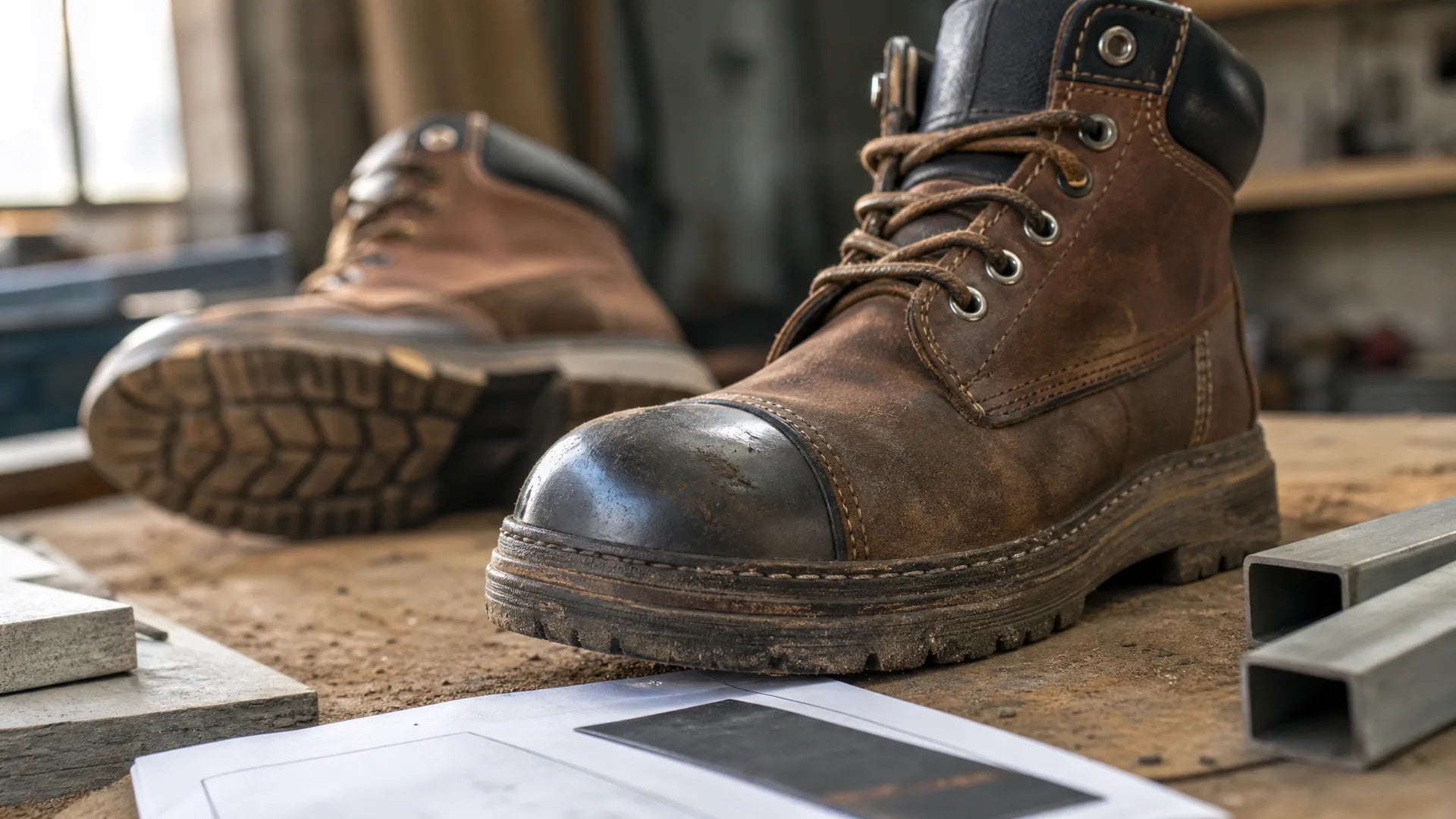
Buying steel toe cap work boots UK tradespeople can trust means looking past the marketing photos and checking the compliance rating on the label. Most listicles rank boots by looks or price alone, with little on what the safety codes actually mean. This guide covers both: the EN ISO 20345 ratings that determine whether a boot is fit for a site, and a set of specific boots you can order today, with direct links to each product page.
WorkStuff UK has supplied workwear, PPE and safety footwear to tradespeople and businesses across Leicestershire and the East Midlands for over 20 years, including B2B credit account customers. That experience shapes the picks below.
What Makes Steel Toe Cap Work Boots UK Compliant in 2026
A boot only counts as safety footwear if it meets a recognised standard. In the UK, that standard is EN ISO 20345. Without a compliant toecap and midsole, a boot is a work boot in name only. A site manager can't sign off on it.
EN ISO 20345 Ratings Explained: S1, S1P, S2, S3
EN ISO 20345:2022 is the current European standard for safety footwear. Boots only count as compliant if they carry markings such as S1, S1P, S2 or S3. Each marking defines resistance to water, punctures and impact.
S1 is the base level. It covers a closed heel, antistatic properties, energy absorption at the heel, and resistance to fuel oil, alongside the toecap's impact and compression protection. S1P adds a penetration-resistant midsole. That protects the foot from sharp objects underfoot, such as nails or screws.
S2 builds on S1P with water penetration and absorption resistance in the upper, which matters on wet or muddy ground. S3 goes further again, adding a cleated outsole for grip along with the penetration-resistant midsole and water-resistant upper. That's why S3 tends to be the minimum spec requested on construction sites. It combines protection against impact, punctures and water in one boot.
Steel Toe vs Composite Toe: Which Suits Your Trade
Steel toecaps are tough, relatively thin, and have been the traditional choice for decades. They handle compression and impact well, but steel conducts heat and cold, so boots can feel colder in winter. Steel also sets off metal detectors, which matters for workers who pass through security checks regularly, such as on airport sites or in some manufacturing plants.
Composite toecaps, usually made from materials like fibreglass or carbon fibre, are metal-free. They don't set off detectors, and they don't transfer temperature the way steel does, which can make them more comfortable in extreme heat or cold. Composite caps are often bulkier for the same level of protection, so the boot can look and feel chunkier around the toe.
Neither is objectively better for every tradesman. Electricians and those working near live equipment often prefer composite for the added peace of mind. General construction workers may not notice much difference either way.
Best Waterproof Steel Toe Boots for Site Work
Wet ground is a daily reality on most UK sites, so waterproofing is not a nice-to-have. These two boots handle mud and standing water while still meeting safety standards.
Mongrel 461 Side Zip Safety Boots for Easy On/Off
The Mongrel 461 side zip safety boots pair a scuff cap with a side zip, so workers can get boots on and off quickly without unlacing them fully. That's useful on sites where boots come off and on several times a day, or where mud and wet ground make laces awkward to manage. The scuff cap adds extra durability at the toe, an area that takes the most wear on rough or wet terrain.

DeWalt Laser Black Safety Hiker for All-Day Comfort
The DeWalt Laser Black Safety Hiker uses a full grain leather upper with a padded tongue and collar, plus a steel toe cap and steel midsole for underfoot protection. TPU heel support and a comfort insole help on long shifts, and the dual density outsole is built for grip on site. Both this boot and the Mongrel 461 use full-protection leather builds aimed at tradespeople who need a side-zip or hiker-style boot for long shifts on site.

S3 Safety Boots UK: Top Picks for Construction
S3 has become the default spec many principal contractors ask for, since it covers impact, penetration and water resistance in one certification. Here are two S3 options at different weights.
Reebok BB4500 S3 HRO for Heavy-Duty Protection
The Reebok BB4500 S3 safety boot is built for tradespeople who want a heavier, full-protection boot for demanding site conditions. The HRO rating adds heat-resistant outsole protection, useful for trades working near hot surfaces or materials.
Portwest Composite Textile Trainer S3S FO SR for Lighter Feet
The Composite Textile Trainer S3S FO SR keeps the S3 rating but swaps the leather boot shape for a breathable knitted trainer upper. It uses a fibreglass toecap and a non-metallic, puncture-resistant midsole, so it's fully metal-free while still meeting S3 requirements. Both this trainer and the Reebok BB4500 carry the S3 rating, the level most commonly specified on construction sites, because it adds waterproof uppers and penetration-resistant midsoles on top of the base S1 protections. Choosing between them usually comes down to whether you want a traditional boot or a lighter trainer-style shoe for the same protection level.

Composite Toe Work Boots and Lightweight Trainers
Not every job needs a heavy leather boot. For lighter trade work, warehouse shifts, or warmer conditions, composite toe work boots in a trainer shape can be a more practical choice.
Himalayan S1PL Trainer for Indoor and Light Trade Work
The Himalayan S1PL safety trainer is rated S1PL SR with a composite toecap and composite midsole. The Flyknit mesh upper and thick padded collar and tongue keep it light and breathable, while a protective TPU scuff cap covers the front of the boot. It's a good fit for light trade work or indoor jobs where a full boot feels like overkill but foot protection is still required. Its S1PL SR rating with composite toecap and midsole shows how a lightweight trainer-style boot can still meet mid-tier safety requirements.
Steelite Lusum S1P HRO Safety Trainer for Warm Conditions
The Steelite Lusum Safety Trainer S1P HRO has a low profile design with a heat-resistant rubber outsole, plus a steel toecap and steel midsole. It's built for trades that want the S1P penetration protection without the weight or bulk of a full boot, and it comes in several colourways for those who prefer something other than black.

Safety Footwear for Food, Catering and Hygiene-Sensitive Trades
Boots built for muddy construction sites aren't right for kitchens, food production lines, or pharmaceutical settings. Those environments need footwear that's easy to wipe down and won't introduce metal contamination risk.
The composite microfibre slip-on safety shoe is metal-free, with an antimicrobial lining and footbed and a wipe-clean upper. The slip-on design means no laces to catch dirt or bacteria, and it's aimed specifically at food, pharmaceutical, catering and hospitality settings.
It carries an S2 rating rather than S3. That means it has water resistance and the base S1 protections, but no penetration-resistant midsole or cleated outsole. For hygiene-sensitive indoor work, that trade-off makes sense, since the risks it protects against differ from a muddy construction site. Choosing between S2 and S3 mainly comes down to matching the rating to the hazards actually present on the job, not simply buying the highest number available.
How to Choose the Right Pair and Order for Your Team
Getting the rating right is only half the job. Fit and comfort determine whether workers actually wear boots properly, all shift, every day.
Comfort Tips for Long Shifts
Sizing varies between brands, so always check the specific size chart for the boot you're buying rather than assuming your usual size carries across. A boot that's slightly loose at the heel will cause blisters over an eight-hour shift. One that's too tight across the toecap will be uncomfortable within an hour.
New leather boots often need a short break-in period before they feel fully comfortable. Wearing them for shorter shifts at first, rather than jumping straight into a full week, helps the leather mould to the foot. A supportive insole and moisture-wicking socks also make a noticeable difference on long days, particularly in boots with steel components that can feel cooler in winter.
Buying in Bulk: Credit Accounts for Businesses
Businesses ordering safety boots for a full team don't need to place separate orders every time someone needs a new pair. Setting up a credit account for team orders lets procurement teams order in bulk and manage payment terms in one place. That's worth doing if you're outfitting more than a handful of staff.
Boots are rarely the only PPE item on a site order. It's worth also reviewing choosing a reliable PPE supplier for site work and pairing safety boots with hi-vis workwear so the rest of the kit meets the same standard as the footwear.
Getting the rating right, choosing steel or composite based on the actual job, and fitting boots properly all matter more than picking whichever pair looks best online. Match the boot to the site, check the EN ISO 20345 marking, and order through a supplier who can support repeat orders as your team grows.