
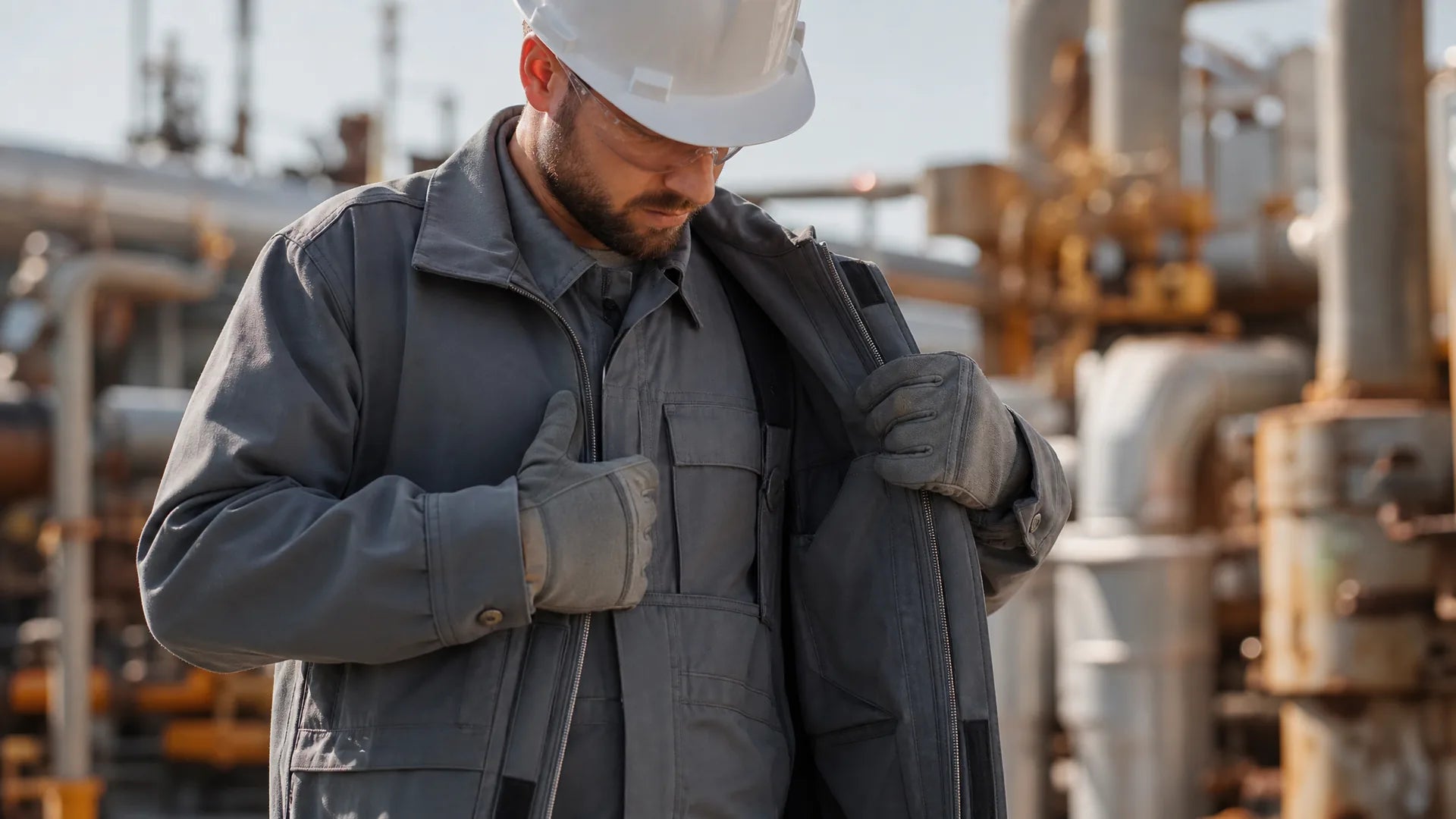
Workers on live electrical systems, welding bays and oil and gas sites face a hazard that ordinary workwear can't handle: fire. Flame resistant workwear UK employers buy for these roles has to do more than look the part. It has to meet a recognised standard, fit the actual task, and hold its protective properties wash after wash. This guide breaks down what the compliance label EN ISO 11612 actually means, which roles need it, and how WorkStuff UK's range fits together for full-body protection.
What Counts as Flame Resistant Workwear in the UK?
Flame resistant workwear is clothing designed to resist ignition, limit flame spread, and reduce burn injury if a worker is exposed to fire or intense heat. It doesn't make someone fireproof. It buys time to escape or extinguish the exposure before serious injury happens.
In the UK, this category sits under PPE regulations. Employers must assess fire and heat risks and supply certified protective clothing where those risks exist. That's different from general workwear that simply looks durable or has a hi-vis colour. FR garments carry specific test certification, usually shown on a sewn-in label with hazard codes and the standard they meet.
FR vs Flame Retardant: Is There a Difference?
The terms get used interchangeably, but there's a useful distinction. Inherently FR fabrics have flame resistance built into the fibre itself, so it can't wash out or wear off over the garment's life. Flame retardant fabrics, by contrast, are usually a standard fabric treated with a chemical finish that gives fire resistance.
Both can meet the same certification if tested correctly. But inherently FR fabrics tend to hold their protective performance longer under repeated washing and heavy wear. That matters for daily workwear rather than occasional-use kit. Either way, the label and test certificate are what actually confirm compliance, not the fabric type alone.
EN ISO 11612: The Core Standard Behind Flame Resistant Clothing
EN ISO 11612 is the main European standard for clothing that protects against heat and flame. It covers garments worn by workers exposed to flame contact, radiant heat, convective heat, molten metal splash or contact heat, depending on the job.
A garment doesn't just pass or fail the standard as a whole. Testers check it against a series of specific hazards, and it only earns the letter codes for the tests it actually passes.
Reading the Hazard Codes on Garment Labels
EN ISO 11612 labels use letter codes to show which hazards a garment has been tested against:
- A1/A2, limited flame spread, tested from the surface or edge of the fabric
- B, convective heat protection
- C, radiant heat protection
- D, protection against molten aluminium splash
- E, protection against molten iron splash
- F, contact heat resistance
A garment might carry just A1 and B, or a fuller set depending on its design and intended use. When you're comparing FR coveralls UK suppliers stock, check which letter codes are printed on the label. Don't assume "FR certified" covers every hazard automatically. A coverall rated for convective heat isn't necessarily rated for molten metal splash, and buying the wrong code for the job leaves a genuine gap in protection.
Where EN ISO 11612 Overlaps With Arc Flash and Hi-Vis Standards
Many roles need more than one type of protection at once. Electricians and utility engineers working near live systems need arc flash protective clothing, tested and rated separately for electric arc exposure, alongside general flame resistance. Roadside and railway crews need flame retardant hi-vis, which combines EN ISO 11612 with the visibility standard EN ISO 20471.
Rather than layering unrelated garments, many multi-hazard FR garments are tested and certified against several standards at once. Portwest's Modaflame range, stocked by WorkStuff UK, is a good example. It combines flame resistance with hi-vis, anti-static and ARC-rated protection in a single garment. Workers who face more than one hazard aren't stuck compromising on one property to get another.
Which Industries Need FR Coveralls UK Workers Can Rely On
FR coveralls are the workhorse of this category because they cover the torso, arms and legs in a single garment, with no gaps at the waist where a jacket might ride up during manual work.
Roles commonly requiring FR clothing in the UK include welders, electricians and utility engineers, oil and gas workers, railway maintenance crews, and steel or foundry operatives. Each of these roles involves either direct flame exposure, hot processes, molten metal splash risk, or electrical arc risk, sometimes several at once.
Coveralls suit these roles because workers wear them all day, over other layers, in physically demanding conditions. A single well-fitted coverall reduces the number of seams and gaps a spark or splash could get through, compared with separate jacket and trouser combinations. For crews moving between indoor plant work and outdoor site visits, a coverall also simplifies kitting: one certified garment instead of coordinating multiple separately-rated pieces.
WorkStuff UK's Flame Resistant Workwear Range
WorkStuff UK has supplied workwear, PPE and hi-vis clothing to UK trades and businesses for over 20 years, including flame resistant ranges for industrial and utility sectors. The range below is built around inherently FR Modaflame fabric, so it's suited to daily wear rather than occasional use.
Coveralls and Jackets for Full-Body Protection
The Modaflame Work HVO Multi-Norm FR Coverall is a straightforward full-body option in orange, sized from S to XXXL, built for workers who need reliable hi-vis and flame resistance in one garment.
The PW3 Modaflame Work HVO Multi-Norm FR Coverall uses the same 280gsm inherent Modaflame fabric but adds stretch panelling, back ventilation, an adjustable waistband, pre-bent sleeves and multiple pockets. It's aimed at workers who need more freedom of movement during physical tasks without giving up protection.
For outerwear, the Modaflame Rain+ Hi-Vis Multi-Norm Contrast FR Jacket combines flame resistance, chemical resistance, anti-static protection, waterproofing and ARC-rated protection in one garment. It's built for workers facing wet weather on top of fire and electrical hazards, such as outdoor utility crews.
The PW3 Modaflame Softshell Hi-Vis FR Gilet uses a 3-layer softshell fabric with heat-applied segmented tape, radio loops and zipped front pockets. It gives sleeveless protection for workers who need freer arm movement.
Layering Pieces: Sweatshirts, Gilets and Base Layers
Underneath a coverall or jacket, the Modaflame Knit Hi-Vis FR Sweatshirt gives inherently flame resistant mid-layer protection with a rib knit cuff and hem for a comfortable fit.
The WX3 Modaflame Knit T-Shirt L/S gives a lighter FR base layer for workers who need a comfortable fit under heavier outer garments.
The Bizflame Hi-Vis FR Long Sleeve Zip Vest is a lightweight zip-front layer for added visibility and hazard protection. Its label is specific: workers must wear it over index 2 or 3 garments to get full flame resistant protection. That single detail is central to how FR layering actually works, and it's worth unpacking on its own.
Layering FR Garments Correctly
FR garments are often assigned an "index" rating based on how much protection they give on their own versus how they perform as part of a layered system. A lightweight FR vest, for example, might not meet full protection requirements by itself, because its lighter fabric weight offers less standalone insulation against heat.
That's exactly the case with the Bizflame vest. It's rated to be worn over index 2 or 3 garments, meaning it depends on a compliant base or mid layer underneath to reach full protection. Wearing it as a stand-alone top garment over an ordinary t-shirt would not meet the certified protection level.
The practical rule for crews is simple: check the label on every FR piece for layering requirements before assuming any single item is fully protective on its own. A coverall is usually self-sufficient. A lightweight vest or gilet often isn't, and needs an FR base or mid layer underneath to do its job properly.
Caring for Flame Resistant Clothing to Keep It Compliant
FR performance isn't permanent regardless of how the garment is treated. Contamination, damage and incorrect washing can all reduce a garment's protective properties, even when the fabric itself is inherently flame resistant.
Fabric softeners are a common cause of degraded FR performance. They can leave a residue on the fibres that affects how the fabric behaves near flame. Oil, grease and other flammable contamination on a garment can also undermine its fire resistance, regardless of the fabric's certification. That's why site policies often require crews to launder FR clothing separately from other work clothes.
Washing, Repairs and When to Retire a Garment
Always follow the specific care label on each garment. Most FR workwear needs washing without fabric softener, at the temperature specified on the label, and without bleach unless the manufacturer states otherwise.
Inspect garments regularly for thinning fabric, holes, frayed seams or heavy staining. Small repairs using non-FR thread or patches can compromise the whole garment's rating. Repairs should use FR-appropriate materials or go through the manufacturer where possible.
Retire a garment once it shows visible damage, heavy contamination that won't wash out, or once it's reached the wear life stated by the manufacturer. Continuing to use a visibly degraded FR garment defeats the purpose of buying certified kit in the first place.
Sourcing FR Workwear for Your Crew
Fitting out a whole team with certified FR coveralls, jackets and layering pieces is a bigger job than a one-off purchase. WorkStuff UK offers B2B onboarding and credit account applications, letting businesses set up ongoing supply of FR workwear across a workforce rather than reordering piece by piece. You can find details on how to apply for a workwear credit account if you're outfitting several workers at once.
If your team also needs standard hi-vis stock alongside FR-rated pieces, it's worth reading about choosing the right hi-vis workwear supplier or browsing the wider what to look for in a PPE supplier guidance before placing a bulk order. For teams wanting matching visibility gear without fire-rated certification, you can also browse the full hi-vis workwear range.
Businesses ordering coveralls and jackets in bulk sometimes want company branding added too. That's covered separately in the guide to branded uniforms for your team.
For crews across Leicestershire and the wider East Midlands, getting FR compliance right starts with matching the correct EN ISO 11612 hazard codes to the actual job risk. Build a layering system around it rather than buying single garments in isolation. Get in touch with the WorkStuff UK team to talk through bulk quotes or credit account setup for your crew's flame resistant workwear.