
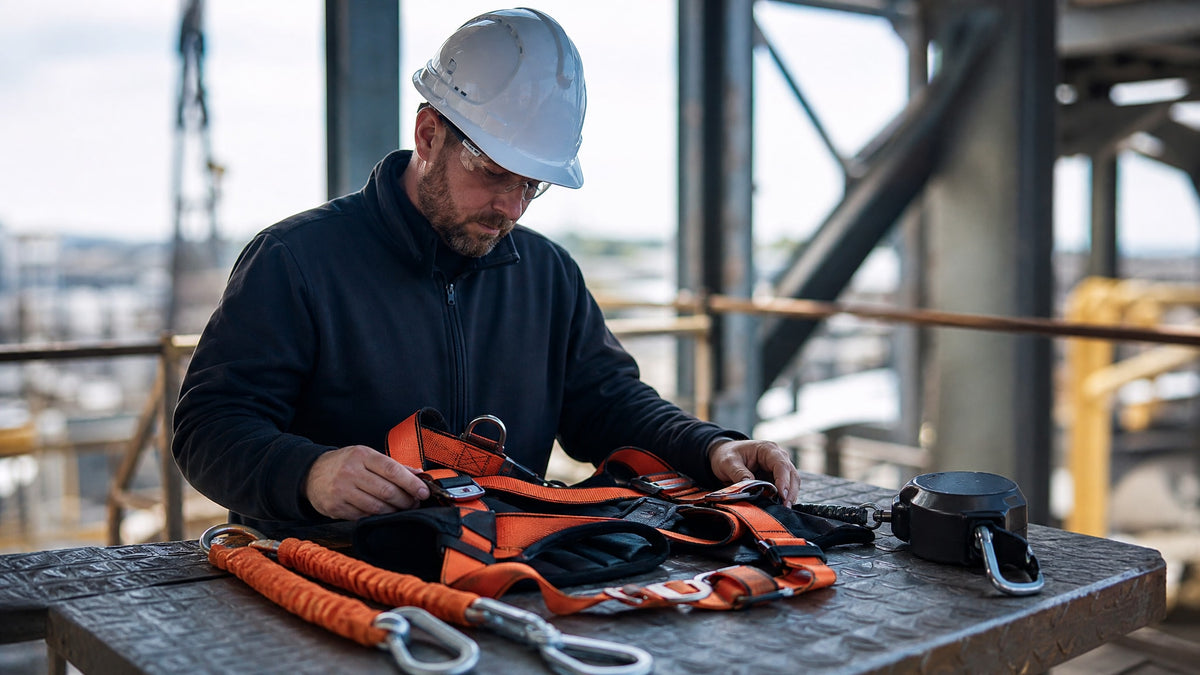
Selecting the right working at height fall arrest equipment UK requires understanding both regulatory obligations and the specific physical demands of your site. Fall arrest systems are personal protective equipment designed to stop a worker who has already fallen. Restraint systems do a different job: they stop a worker reaching the hazard in the first place. For tradespeople and procurement teams across Leicestershire and the East Midlands, specifying compliant kit isn't about ticking boxes. It's about making sure every team member goes home at the end of the shift.
This guide covers the practical selection of harnesses, lanyards and blocks within the Portwest range available through WorkStuff UK. We look at when each component is legally required, how they work together as a system, and the maintenance standards needed to keep your equipment compliant. Whether you're outfitting one operative or setting up bulk supply for a large workforce, getting the specification right prevents accidents and meets Health and Safety Executive expectations.
UK Working at Height Regulations and Equipment Requirements
The Work at Height Regulations 2005 set out a clear hierarchy. Employers must first avoid work at height wherever possible, then use collective protection such as guardrails, before turning to personal fall protection. You must provide suitable, inspected PPE for any task where a fall hazard remains once every other preventative measure has been used up. This means that buying PPE required by law in the UK is the final step in a risk assessment, not a substitute for safer working methods.
Employers carry full responsibility for making sure any fall arrest system supplied suits the specific task and environment. The regulations require that equipment be properly maintained, regularly inspected, and used only by trained people who understand its limits. A generic approach fails here, because different tasks demand different configurations: what protects a roofer may not suit someone working a confined vertical shaft. Your risk assessment needs to record why personal fall arrest was chosen over collective measures, and confirm the equipment matches the hazards identified.
Compliance also covers the anchor points themselves, which must withstand the forces generated during a fall arrest event. Without a certified anchor, even the best harness and lanyard combination becomes useless, and potentially dangerous. Site managers often miss this link between the worker's PPE and the structure, assuming existing fixtures are adequate without checking. Anchor integrity is as much a legal obligation as providing the harness itself.
Choosing the Correct Harness for Working at Height
A full-body harness is the mandatory anchor point for any personal fall arrest system in the UK. It spreads arrest forces across the thighs, pelvis, chest and shoulders to limit injury. Work positioning belts alone don't count as fall arrest equipment under UK regulations; only a full-body harness connected to a suitable anchorage gives you fall arrest capability. Belts can hold a worker in position, but they can't safely stop a free fall, which rules them out as primary protection wherever fall risk exists.
When choosing a harness for your team, fit and adjustment range matter as much as certification marks, because an ill-fitting harness can cause serious injury during suspension or fail to deploy correctly. Check that the harness fits the full range of body sizes in your workforce, with room for winter clothing and tool belts worn underneath. Adjustment points should be easy to reach and secure, so operatives get a snug fit without loose webbing that could snag on site hazards. Markings such as EN 361 need to stay legible and current: faded or missing labels make the equipment non-compliant regardless of its actual condition.
Think about the attachment points your tasks need, since harnesses offer dorsal, sternal or lateral D-rings for different applications. A dorsal attachment is standard for general fall arrest, while sternal points suit rescue scenarios or ladder climbing systems. Lateral points enable work positioning when paired with the right lanyards, though these must never serve as sole fall arrest anchors. Matching the harness configuration to the actual work keeps things both safe and efficient on site.
Selecting Lanyards and Restraint Systems for Site Safety
Knowing the difference between energy-absorbing lanyards and restraint lanyards is fundamental to specifying safe height access systems. Energy-absorbing lanyards are designed to limit arrest force to below 6kN during a fall, protecting both the worker and the anchor point from excessive shock loading. They use a tear-webbing mechanism, or similar, that deploys progressively to slow the falling worker, and they're required wherever there's any chance of a free fall.
Restraint lanyards do a different job: they physically stop the wearer reaching an unprotected edge or hazard zone. The Single 1.5m Restraint Lanyard is a good example, with a fixed length that restricts movement rather than absorbing energy. Specify restraint systems whenever the work can be completed without exposing operatives to fall risk, since prevention always beats arrest. Restraint lanyards have no shock absorbers, so they must never be used where a fall could occur; they'd transmit lethal force straight to the worker's body.
For tasks needing mobility along scaffolding or structures, where continuous tie-off matters, twin-tail lanyards protect workers during the transition between anchor points. The Double 1.8m Lanyard With Shock Absorber has two connection points, allowing 100% tie-off during movement, a critical feature on scaffolding. The Single Elasticated 1.8m Lanyard With Shock Absorber, by contrast, uses elasticated webbing to cut trip hazards while still giving certified fall arrest protection. Each option suits different movement patterns and anchor layouts, so your choice should reflect what's actually on your site.
Fall Arrest Blocks Versus Standard Lanyards
Fall arrest blocks work differently from standard lanyards: they use an automatic retraction and locking mechanism, similar to a car seatbelt. This gives continuous protection during vertical movement without manual adjustment or conscious effort from the user. The block pays out line as the worker climbs and locks instantly on sudden acceleration, arresting the fall within centimetres rather than metres.
This automatic response makes fall arrest blocks especially useful for ladder access, roof entry points, or any situation involving vertical transitions where a trailing lanyard is hard to manage. Standard lanyards need the operative to manually clip and unclip between anchor points, creating moments of vulnerability at each transition and demanding constant attention to stay protected. Blocks remove that cognitive load, cutting the room for human error in high-risk environments. They typically only work in near-vertical orientations, though, and may not function correctly used horizontally or at shallow angles, so it's worth understanding their operational envelope before you specify one.
Clearance requirements also matter when choosing between blocks and lanyards, since deployment distances vary significantly between systems. Blocks generally arrest falls faster, but they still need enough headroom below the worker to stop ground contact during the arrest sequence. Manufacturer specifications set minimum clearance distances, and these need checking against your site conditions before use. Specify the wrong device for the available space and the protection becomes ineffective, whatever its certification says.
Essential Complementary PPE for Height Safety Teams
Fall arrest equipment protects against falls but does nothing about the other hazards present at height, which is why complementary PPE matters for full protection. Head protection stays mandatory on virtually all construction sites, and the Expertbase Wheel Safety Helmet, Portwest's best seller, offers wheel ratchet adjustment across sizes 55-62cm with a 4-point textile suspension harness for secure fit, at around £9.35. Helmets need to be compatible with your chosen harness and any face or hearing protection the task also requires. Where a helmet isn't mandated but face and hearing protection still are, the PPE Protection Kit, priced around £21.25, protects against particle impact, liquid splashes and dangerous noise without the helmet shell.
Eye protection matters just as much when working overhead, where debris, dust or tools may fall from above. The Wrap Around Plus Safety Glasses, around £2.88, pair anti-scratch and anti-fog lens coatings with a removable gasket for a better seal against particulates. Choosing the right safety spectacles for construction sites keeps vision clear throughout the working day. Fogged or scratched lenses create a hazard of their own by impairing visibility, so lens treatment quality matters as much as impact rating.
Footwear and visibility complete the picture for height workers, who often operate in exposed or low-light conditions. Appropriate high-visibility clothing keeps workers visible to crane operators, vehicle drivers and colleagues below. Safety footwear with a steel toecap and steel mids, such as the PU Safety Wellington S5 FO CI SR at around £53.13, guards against dropped objects and puncture hazards common on elevated platforms, and its kick-off lug makes it easy to remove at the end of a shift. Skip these supporting elements and you undermine the whole safety system, even when the fall arrest equipment itself is correctly specified and maintained.
Inspection and Maintenance of Height Safety Equipment
All fall arrest equipment needs a pre-use visual check by the wearer and periodic detailed inspection by a competent person to stay compliant with UK safety standards. Pre-use checks should catch obvious damage, cuts, abrasions, chemical degradation, distorted hardware or a deployed shock absorber, before every shift. Find a defect and the equipment comes out of service immediately; there's no acceptable threshold for damage in life-critical kit. You can't defer repairs or keep using compromised equipment while waiting on replacement stock.
Periodic inspections need to happen at intervals the manufacturer sets, typically every six months for equipment in regular use, though harsher environments may call for more frequent checks. These inspections require documented competence and should follow manufacturer guidance covering stitching, webbing condition, hardware function and label legibility. Keep records of each inspection as evidence of compliance and to track the equipment's working life. Our PPE compliance checklist helps make sure nothing in the inspection protocol gets missed during routine audits.
Storage conditions affect equipment longevity and performance significantly, so proper care between uses matters as much as the formal inspection. Store harnesses and lanyards clean, dry, and away from direct sunlight, chemicals, sharp edges and extreme temperatures. UV exposure degrades synthetic fibres over time even without visible damage, while chemical contamination can weaken materials invisibly. Equipment that has arrested a fall must come out of service immediately, and be destroyed or sent back to the manufacturer for assessment, since internal damage may not show on the outside.
Sourcing Compliant Height Safety Equipment in the UK
Checking supplier credentials and product certification matters when you're buying fall arrest kit, because it's the only way to be sure of genuine compliance and safety performance. Counterfeit or substandard PPE enters supply chains regularly, and price alone never tells you whether something is genuine or well-made. Ask for declarations of conformity, test certificates and traceability documentation for every batch of height safety equipment you buy. Reputable suppliers keep these records on hand and welcome the scrutiny, because their business runs on trust and repeat custom rather than one-off sales.
WorkStuff UK has supplied compliant PPE and workwear to UK tradespeople and businesses for over 20 years, and we provide practical guidance on selecting certified height safety equipment alongside it. As a height safety equipment supplier serving Leicestershire and the East Midlands, we know the specific demands of local industry and how enforcement works on the ground. Our Portwest fall arrest range includes harnesses, lanyards and complementary PPE chosen for durability and compliance rather than lowest price. Businesses needing ongoing supply can apply for B2B accounts with credit terms, which streamlines procurement for teams that need steady access to compliant equipment without administrative friction.
Bulk purchasing decisions should weigh total cost of ownership, inspection costs, replacement cycles and training requirements, rather than unit price alone. Cheap equipment that fails inspection early or needs frequent replacement ends up costing more than durable alternatives that hold compliance over a longer service life. Bring in a knowledgeable supplier early in your specification process and you avoid costly mistakes, with equipment matched to your actual site conditions from the start. Contact WorkStuff UK to discuss your height safety requirements, or browse our Portwest range online to find certified solutions for your workforce.
Frequently Asked Questions
At what height should fall arrest devices be used?
UK regulations do not specify a minimum height threshold for fall arrest equipment; the requirement depends entirely on risk assessment rather than measurement. If collective protection cannot eliminate fall risk and a fall could cause injury, personal fall arrest becomes necessary regardless of whether the work is at two metres or twenty. Low-height falls onto hard surfaces or into machinery can be fatal, so focus on hazard severity rather than arbitrary height limits.
What equipment is needed for working at height?
Essential equipment includes a certified full-body harness, appropriate lanyard or fall arrest block, compatible anchor point, helmet, eye protection, and high-visibility clothing. The specific configuration depends on your risk assessment findings, with restraint systems preferred where they can eliminate fall exposure entirely. All components must carry current CE or UKCA marking and be inspected before each use.
What are the types of fall arrest equipment?
Primary fall arrest equipment comprises full-body harnesses, energy-absorbing lanyards, twin-tail lanyards for continuous tie-off, and automatic fall arrest blocks for vertical access. Restraint lanyards prevent reaching hazards but do not arrest falls and must never substitute for arrest equipment where fall risk exists. Each type serves distinct functions and must be selected based on task requirements, anchor availability, and clearance distances.